 Skip to content

📖 On this page
- What Is the Red Thread, Really?
- Kabbalah & the Left Wrist
- Hinduism: Kalava & Ceremony
- Chinese Folklore & the Thread of Fate
- How to Wear a Red String Bracelet
- Protection & Spiritual Shielding
- Beyond the Wrist: Necklaces & Rings
- How to Choose a Red String Bracelet
- Does It Actually Work? A Psychological Take
- FAQs
If you've ever spotted a thin red thread around someone's wrist and wondered what it stands for—you're not alone.
I get asked about this all the time. People notice the bracelet, they ask if it's "just jewelry" or if there's something more going on. The short answer? It depends on who you ask.
But across three major traditions—Kabbalah, Hinduism, and Chinese folklore—the red thread carries weight. Protection. Destiny. A quiet kind of spiritual muscle.
Here's what each of those traditions actually says about the red string, why it matters, and what it might mean for you.
What Is the Red Thread, Really?
Let's clear one thing up right away: this isn't a scientific theory. Nobody's publishing peer-reviewed papers on red string efficacy.
But as a cultural and spiritual symbol, the red thread has been around for thousands of years—and it shows no signs of fading.
At its core, the red string is a physical anchor. A reminder. In some traditions, it's seen as an amulet that symbolically represents protection from negative energy.
In others, it's a sign of faith—a way of saying "I trust that something bigger than me is at work."
People wear these bracelets for all kinds of reasons. Spiritual protection. Emotional comfort. Aesthetic minimalism. Or simply because someone they love tied it on their wrist and said, "This is for you."
Kabbalah: The Left Wrist & Rachel's Tomb
In Jewish mysticism—specifically Kabbalah—the red string is almost always worn on the left wrist.
Why? Because Kabbalistic teaching holds that the left side of the body is the receiving side. It's where external energy flows in. So the idea is that placing the string there helps filter what comes in.
The ritual matters, too. Traditionally, the string is made of red wool—not synthetic fiber—and it's often wound around the wrist seven times.
That number isn't random: it echoes the seven days of creation and the seven spiritual realms in Kabbalistic cosmology.
Some practitioners take it a step further. The string is blessed at Rachel's Tomb in Bethlehem, a site associated with the biblical matriarch Rachel, who's revered for her compassion and protective energy.
Tying the string there is believed to channel that maternal protection directly to the wearer.
Not everyone follows these rituals to the letter—and that's fine. But for those who do, the red string isn't an accessory. It's a deliberate, sacred act.
Hinduism: Kalava, Mauli & Ceremonial Intention
In Hindu tradition, the red string goes by a few names—kalava or mauli being the most common. It's tied during religious ceremonies, prayers, and festivals.
Unlike Kabbalah's fixed left-wrist rule, Hindu practice is more flexible. The wrist depends on the ceremony, the deity being invoked, or even the priest conducting the ritual.
What is consistent is the intention. Tying the kalava is an act of devotion. It's a visual and tactile way of saying, "I'm open to blessings. I'm grounded in my faith."
In many regions of India, it's still an everyday part of life—especially during holidays, weddings, and rites of passage.
There's something beautiful about that, I think. The red string isn't a passive charm. It's a reminder that you're connected to something larger than your to-do list.
Chinese Folklore: The Red Thread of Fate
Now here's where the red thread takes a different turn.
In Chinese folklore, the Red Thread of Fate is an invisible cord tied by the gods around the ankles of two people destined to meet.
It doesn't matter how far apart they are, or how long it takes—the thread never breaks. It might stretch. It might tangle. But it holds.
This isn't just about romance, either. The Thread of Fate applies to friendships, mentorships, and even pivotal life encounters. Wearing a red string in this tradition is a quiet act of faith—a way of saying "I trust the timing of the universe."
If you're navigating a transition, a new relationship, or just the general uncertainty of life, this symbolism can hit pretty hard.
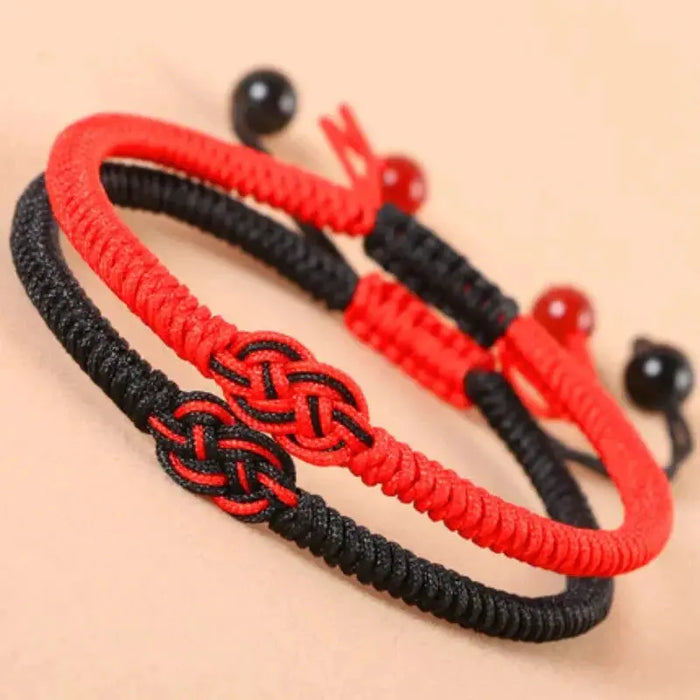
How to Wear a Red String Bracelet: Left Wrist, Right Wrist & Traditions
One of the most common questions I get is: which wrist does it go on? The answer, like most things with the red string, depends on who you ask.
In Kabbalah, the left wrist is the clear choice. It's considered the "receiving" side of the body—where external energy enters—so wearing it there is a way of filtering what comes in.
Hinduism is more flexible. The wrist often depends on the specific ceremony or deity being honored. Sometimes men wear it on the right and women on the left.
Chinese tradition doesn't prescribe a specific wrist—it's more about the intention behind the thread than the placement.
If you're still unsure, here's a practical rule of thumb: wear it on the wrist that feels right to you. Some people choose their non-dominant hand for comfort. Others go with the left because they connect with the Kabbalistic idea of receiving protection. There's no wrong answer here.
One thing most traditions agree on: once you put it on, leave it alone. Let it wear down naturally. Many believe that when it falls off on its own, it's done its job.
📖 Read more: Red String Bracelet: Left or Right Wrist? Meaning, Tradition & How to Choose →
Protection & Spiritual Shielding
Beyond love and fate, the red string has a more straightforward job: keeping bad energy out.
I've had people tell me they feel drained after visiting certain places—crowded airports, tense meetings, even family gatherings that go sideways.
Whether you call it "bad vibes" or "energetic pollution," the red string is believed by many to symbolically represent protection from that kind of interference.
Some people combine the red string with an Evil Eye charm for extra coverage. Different traditions, same goal: stay energetically balanced. If you're curious, our Red String Evil Eye Bracelet brings both symbols together in one piece.
Beyond the Wrist: Necklaces, Rings & Other Variations
Bracelets get all the attention, but the red string shows up in other jewelry forms too—necklaces, earrings, and rings. Each one lands differently.
A red string necklace sits closer to the heart or throat chakra, which makes it a popular choice for people seeking emotional protection or clearer communication.
A red string ring does something else entirely: it's quiet, subtle, and easy to overlook—which is exactly why some people love it. It's a private intention setter, a daily whisper to yourself about what you're working toward.
The rise of minimalist jewelry has brought these pieces into the mainstream, but they're not just trends. They're functional symbols for people who want to align their style with their values.
How to Choose a Red String Bracelet
With so many options out there, picking the right red string can feel overwhelming. Here's how to narrow it down.
Ask yourself: Why am I wearing this? Protection? Love? A daily reminder to stay grounded? Your reason shapes everything else.
Cotton and wool are classic. Silk feels more luxurious. If you want something durable for daily wear, waxed cotton or nylon hold up well.
An Evil Eye charm doubles down on protection. Rose quartz adds a love element. Lava stone can absorb essential oils if you want a subtle scent anchor.
Adjustable knots give you flexibility. Fixed sizes are cleaner but less forgiving. Measure your wrist before you buy.
If you're not sure where to start, I'd say this: go with what speaks to you. The red string works best when it feels personal. Whether that's a simple cotton thread or a beaded piece with gemstones, the meaning is yours to define.
📖 Read the full guide: Red String Bracelet: Left or Right Wrist? →
Does It Actually Work? A Psychological Take
Let's be honest: no study has proven that a red string blocks negative energy. But that's not really the point.
What we do have evidence for is the power of ritual. A 2014 study in the Journal of Experimental Social Psychology found that performing symbolic actions—like tying a string with intention—can reduce anxiety and increase a sense of control in uncertain situations.
Think of the red string like a mindfulness anchor. It doesn't have magical properties in a lab-testable sense. But if every time you glance at your wrist, you take a breath and remember what matters to you—that's real. That's doing something.
Some people call it the placebo effect. I call it using your brain the way it was designed: by attaching meaning to objects and rituals that help you show up better in your own life.


Red Thread Traditions at a Glance
| Tradition | Name | Wrist | Core Meaning | Ritual Detail |
|---|---|---|---|---|
| Kabbalah | Red String | Left (receiving side) | Symbolic protection | Wound 7 times, often blessed at Rachel's Tomb |
| Hinduism | Kalava / Mauli | Varies by ceremony | Blessings, devotion, strength | Tied during puja (prayer ceremonies) |
| Chinese Folklore | Red Thread of Fate | No strict rule | Destiny, connection, divine timing | Often paired with jade or coins |
💬 From someone who wears one
"I started wearing a red string after a really rough breakup. Not because I thought it would 'fix' anything—but because every time I looked at it, I remembered to be gentle with myself. That was three years ago. I still wear it."
— Sarah, New York
"My grandmother tied a kalava on my wrist before every exam. Now I tie one on my daughter's wrist before her school tests. It's not about luck—it's about knowing someone's rooting for you."
— Anjali, California
Frequently Asked Questions
1. What does a red string bracelet actually symbolize?
It depends on the tradition, but the common thread (no pun intended) is protection, intention, and connection.
Some wear it for spiritual reasons, others for emotional grounding or simply as a meaningful accessory.
2. Which wrist should I wear it on?
In Kabbalah, the left wrist is the receiving side—so that's where protection goes. Hindu traditions are more flexible; it depends on the ceremony. If you're unsure, just pick the wrist that feels right.
3. Can I wear a red string if I'm not religious?
Absolutely. Plenty of people wear red strings purely for personal symbolism, style, or emotional comfort. The meaning is yours to define.
4. What does it mean if my red string breaks or falls off?
Many traditions interpret this as a sign that it's served its purpose. If it breaks, replace it—don't just re-tie it.
In some practices, you bury the broken string or place it in flowing water as a gesture of release.
It's also a moment to pause and ask yourself: What was I protected from? What am I ready to let go of?
5. Can I give a red string bracelet as a gift?
Yes—and it's actually one of the best gifts you can give. It carries protection, love, and good intentions. Just include a note explaining why you chose it for them.
6. Are there any rules I should follow?
A few common guidelines:
(1) In Kabbalistic practice, don't remove it for the first 7 days.
(2) Avoid letting others touch or remove your string—the energy is personal.
(3) If it gets wet, air-dry it; heat can damage the fiber.
(4) In some Hindu traditions, the kalava is removed before eating non-vegetarian food. Always check with your tradition for specifics.
Tradition meets intention—find yours.
Explore the Red String Bracelet Collection
📖 Related Red String Bracelet Guides:
Kabbalah & Buddhist Traditions
1. Kabbalah Red String Bracelet Meaning: Protection, History & How to Wear It
2. The Meaning of the Buddhist Red String Bracelet: Karma, Protection, and Spiritual Power
3. Dorje Knot Red String Bracelet: What It Means and How to Wear It
Meaning, Luck & Protection
4. Red String Bracelet Meaning: Protection, Luck & Spiritual Symbolism
5. Red and Black String Bracelet Meaning: Protection, Grounding & Balance
Wearing the Red String
6. Red String Bracelet: Left or Right Wrist? Meaning, Tradition & How to Choose
7. Red String Bracelet Rules: 7 Things to Know Before Wearing One


