 Skip to content

In This Guide
- How to Choose Based on Intention
- Crystal Durability Quick Reference
- Protection & Grounding: Black Obsidian & Hematite
- Calm & Mindfulness: Amethyst & Lava Stone
- Wealth & Abundance: Jade & Tiger Eye
- Care & Maintenance
- Buddhist vs Regular Crystal Bracelets
- Frequently Asked Questions
- Quick Pick: 30-Second Decision Guide
A bracelet can be more than something you wear to complete an outfit. Sometimes, the smallest objects become the ones we reach for when we need a moment of balance.
I bought my first Black Obsidian bracelet three years ago, during a month when I was sleeping maybe four hours a night. The beads arrived cold—not "spiritually cold," just physically cold from the mail truck in February.
I remember rolling them between my thumb and forefinger during a 2 p.m. meeting, not for any ritual reason, just because the texture gave my hands something to do besides check my phone. That was the beginning.
That is why many people choose Buddhist bracelets as more than spiritual jewelry. A bracelet inspired by Buddhist traditions can become a daily touchpoint—a physical reminder to slow down, reconnect with your intentions, and stay present in a world that rewards distraction.
The stone you choose adds another layer of meaning. Some are drawn to Black Obsidian when they want a stronger sense of protection and grounding. Others choose Amethyst for moments of calm, while Jade and Tiger Eye are often selected by those who want to welcome confidence, abundance, and good fortune into their daily life.
This guide covers how different crystals align with different intentions—and how to choose a Buddhist crystal bracelet that fits your lifestyle, not someone else's idea of what spiritual jewelry should look like.

Explore our full collection of Buddhist Bracelets designed for mindfulness, protection, and spiritual balance.
Which crystal is best for a Buddhist bracelet?
The best crystal for a Buddhist bracelet depends on your personal intention.
Black Obsidian and Hematite are commonly chosen for grounding and protection, Amethyst for calm and mindfulness, while Jade and Tiger Eye are popular choices for prosperity, confidence, and good fortune.
There is no universal "best"—the right stone is the one that resonates with what you're moving through right now.
How to Choose a Buddhist Bracelet Based on Your Intention
Choosing a Buddhist bracelet is a personal decision. There is no single stone that suits everyone.
The bracelet that feels meaningful to you often depends on what you are navigating in your current season of life—whether that's stress, transition, creative work, or simply the desire for a daily reminder to pause.
Traditional Buddhist bead bracelets originated as tools for mindfulness and meditation. Mala beads—strands of 108 beads—have been used for centuries to count prayers or mantras during practice.
Today, many people wear Buddhist-inspired bracelets in a similar spirit: as a small physical anchor that brings attention back to the present moment when the mind wanders.
The crystal becomes part of that anchor. When you glance down at your wrist during a stressful meeting, a difficult conversation, or a quiet morning meditation, that small touchpoint can pull your focus back to your intention—not by magic, but by deliberate association that you build over time.
| Your Intention | Recommended Crystal | Symbolic Meaning |
|---|---|---|
| Protection & Grounding | Black Obsidian, Hematite | Stability, strength, staying centered |
| Calm & Mindfulness | Amethyst, Lava Stone | Reflection, relaxation, emotional balance |
| Wealth & Abundance | Jade | Harmony, prosperity, good fortune |
| Confidence & Action | Tiger Eye | Courage, focus, determination |
If you are new to crystal bracelets, start with one intention that connects to your everyday life. Your bracelet does not need to represent everything at once. One meaningful reminder is enough.
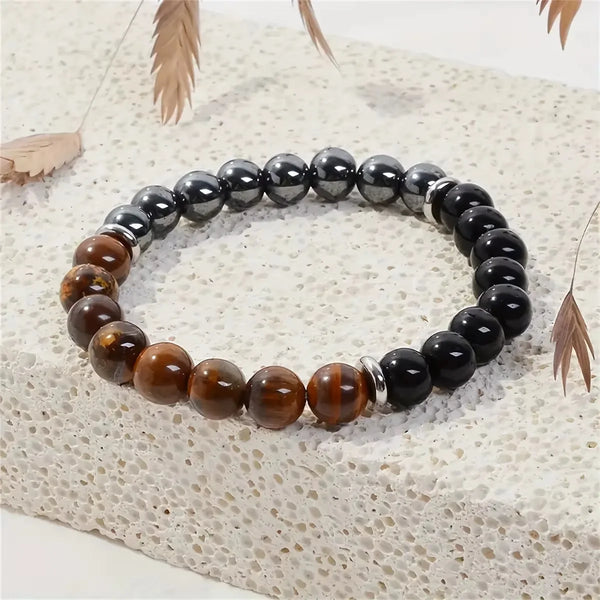
Browse our Buddhist Bracelet collection to find natural stone combinations aligned with different intentions.
Crystal Durability Quick Reference: What Your Lifestyle Demands
Before you choose a stone based on meaning alone, consider your daily routine. Different crystals have different hardness levels, and that affects how well they hold up to your lifestyle.
This table uses the Mohs hardness scale (1 = softest, 10 = hardest) to help you match a bracelet to how you actually live—not how you think you should live.
| Crystal | Mohs Hardness | Best For | Avoid If |
|---|---|---|---|
| Black Obsidian | 5–5.5 | Desk work, casual daily wear | Gym workouts, contact sports, frequent drops |
| Hematite | 5.5–6.5 | Office, commuting, everyday wear | Prolonged water exposure (showering, swimming) |
| Amethyst | 7 | All-day wear, stacking, active routines | — (durable enough for most lifestyles) |
| Lava Stone | 3–3.5 | Gentle wear, aromatherapy use | Heavy impact, gym, rough handling |
| Jade (Nephrite) | 6–6.5 | Daily wear, professional settings | Harsh chemicals, ultrasonic cleaners |
| Tiger Eye | 7 | Gym, active lifestyle, stacking | — (one of the toughest options) |
Best Buddhist Bracelets for Protection & Grounding: Black Obsidian and Hematite
Some days feel heavier than others.
Maybe it was a difficult conversation at work. Maybe you spent hours absorbing stressful news and social media. Maybe you walked into a room and immediately felt your own energy shift in response to the people around you.
A Buddhist protection bracelet is not about walking through life braced for something negative. For most wearers, it represents a personal boundary—a small physical reminder to stay centered and connected to yourself when external noise gets loud.
Black Obsidian Buddhist Bracelet: Protection & Inner Strength
Our Black Obsidian beads are 8mm, cut from volcanic glass sourced in Mexico.
The first thing you notice holding them: they are not uniform black. Under direct sunlight, some beads reveal faint gray banding—a natural inclusion that dyed imitations cannot replicate.
Run your thumb across the surface and it feels cool, dense, almost glass-smooth. There is no grit, no wax coating.
Many people choose Black Obsidian because it symbolizes grounding, protection, and inner strength. Modern practitioners often describe it as a physical reminder to protect your peace and stay aware of your own thoughts—rather than absorbing everything around you.
The deep black design makes it one of the easiest bracelets to wear daily. It works with a T-shirt and jeans, with business attire, and layered with other bracelets without dominating the stack.
A Black Obsidian bracelet paired with Hematite or sandalwood beads creates a wristscape that feels intentional, not decorative.
Explore our Black Obsidian Buddhist Bracelets for a grounding everyday style.
Hematite Buddhist Bracelet: Grounding a Busy Mind
Hematite has a completely different physical presence from Black Obsidian.
It is noticeably heavier—a 21-bead bracelet weighs roughly 45 grams, almost twice the weight of an Amethyst bracelet with the same bead count.
When you turn your wrist, the beads shift with a subtle momentum you can feel against your skin.
For people who spend long hours on computers, managing teams, or switching between tasks all day, that weight becomes a tactile anchor.
One customer described wearing hers specifically on back-to-back Zoom days, because rolling a heavier bead between her fingers gave her something physical to focus on when she could not step away from the screen.
The metallic gunmetal finish also makes Hematite one of the most versatile bracelets for stacking—it pairs cleanly with Black Obsidian, leather, or a silver watch without looking busy.
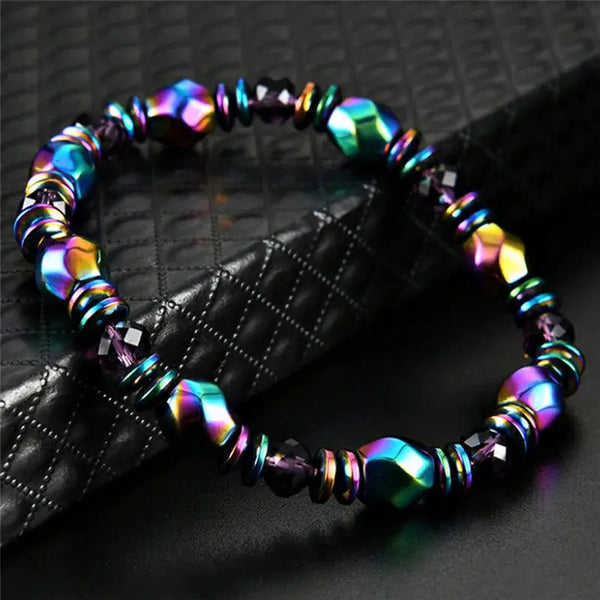
Shop our Hematite Buddhist grounding bracelets.
Best Buddhist Bracelets for Calm, Relaxation & Mindfulness: Amethyst and Lava Stone
There are days when your calendar looks normal from the outside, but your mind feels completely full.
Too many notifications. Too many decisions. Too many thoughts competing for attention at once.
The practice of touching beads has been connected with meditation traditions for centuries.
Running your fingers across each bead creates a small pause—a chance to take one conscious breath before continuing.
Paired with calming stones, a Buddhist bracelet shifts from accessory to part of a personal mindfulness practice.
Amethyst Buddhist Bracelet: Peace and Reflection
Amethyst varies more than most people expect. Our current batch leans toward muted lavender with milky inclusions under indoor light, then deepens to saturated violet in direct sun.
I have noticed cheaper bracelets often use heat-treated Amethyst that shifts brownish-orange at certain angles—a telltale sign of lower-grade material. Ours are untreated; the color range you see is what the earth produced.
Where Black Obsidian feels bold and protective, Amethyst feels quieter. It is the bracelet I reach for on mornings when my to-do list is long but my internal bandwidth is thin—a visual cue to slow my breathing and create more space between stimulus and reaction.
For meditation, journaling, yoga, or evening reflection, an Amethyst bracelet fits naturally.
It also stacks beautifully with neutral Lava Stone, sandalwood Mala beads, or a simple silver bracelet for a look that balances spiritual and modern.
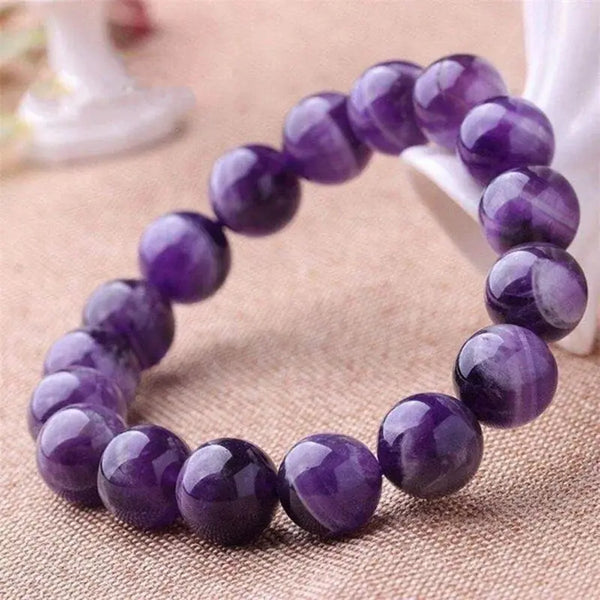
Discover our Amethyst Buddhist Bracelets.
Lava Stone Buddhist Bracelet: Grounding Through Nature
Lava Stone has a completely different personality from polished gemstones. Formed from volcanic basalt, each bead carries a rough, matte texture that no two pieces replicate exactly.
The surface is porous—visibly so—which is not a flaw. It is the feature that makes these bracelets uniquely versatile.
Here is how the essential oil function actually works: add 1–2 drops of oil directly to 2–3 beads (not the whole bracelet, or the scent gets overwhelming). The porous basalt absorbs the oil within 30 seconds and releases it subtly for 4–6 hours.
Lavender lasts about half a workday; sandalwood or vetiver tends to hang around longer. One practical note: dark oils like patchouli can stain lighter clothing, so stick to clear or light-colored oils if you wear a lot of white.
Lava Stone is especially popular for men's bracelets because of its matte black finish and natural, unfussy texture. It pairs easily with watches, leather bands, and other bracelets without looking styled or precious.
Try combining Lava Stone with Amethyst for a calm-focused stack, or pair it with Tiger Eye when you want a combination that feels more active and confident.
Explore our Buddhist Crystal Bracelets.
Best Buddhist Bracelets for Wealth, Luck & Abundance: Jade and Tiger Eye
When people talk about wealth, they are not always talking about money alone. For many, abundance means having confidence in decisions, recognizing opportunities, building meaningful relationships, and creating a life that feels balanced rather than constantly chasing the next milestone.
Jade and Tiger Eye are popular choices in Buddhist-inspired jewelry not because they promise instant success, but because they serve as reminders of patience, wisdom, courage, and intentional action.
Jade Buddhist Bracelet: Harmony, Prosperity & Good Fortune
Let us be direct: the word "Jade" gets used loosely in the jewelry industry. Much of what is sold as Jade online is actually dyed quartz, aventurine, or glass.
Real Jade falls into two categories—Jadeite (rarer, more expensive, primarily from Myanmar) and Nephrite (more common, historically significant, found in China and British Columbia).
Our bracelets use Nephrite Jade sourced from Canada. It has a characteristic spinach-green color with natural black speckling—not the uniform artificial green of dyed imitations.
Hold it up to light and you will see subtle variations in tone across the beads. That inconsistency is exactly what you want to see. If a "Jade" bracelet costs $12 and looks perfectly uniform green, it is probably not Jade.
Jade represents prosperity in the broader sense: harmony, wisdom, and appreciation for what you already have alongside your goals for growth. It pairs beautifully with gold accents, sandalwood beads, or a simple black bracelet for a refined stack.
Explore our Jade Buddhist Bracelets.
Tiger Eye Buddhist Bracelet: Confidence, Courage & Success
Tiger Eye's signature effect—a shifting band of golden-brown light that moves as you turn your wrist—is called chatoyancy, from the French œil de chat meaning "cat's eye."
This is not a surface coating. It is caused by fibrous mineral inclusions inside the stone that reflect light in parallel.
Lower-grade beads look flat brown with barely any movement; high-grade beads show a sharp, distinct band that tracks the light like an eye following you across the room.
Ours are sourced from South Africa, which produces some of the sharpest chatoyancy available.
Many people choose Tiger Eye when they want a reminder of focus and courage—the bracelet for moments that require action.
Before an important meeting, a new project, or a difficult decision, touching the beads can become a small personal ritual: trust yourself and move forward.
Tiger Eye is also one of the most durable stones for daily wear (Mohs 7), making it ideal for stacking with Black Obsidian, Hematite, or leather bracelets. The warm golden tones work equally well for men and women.
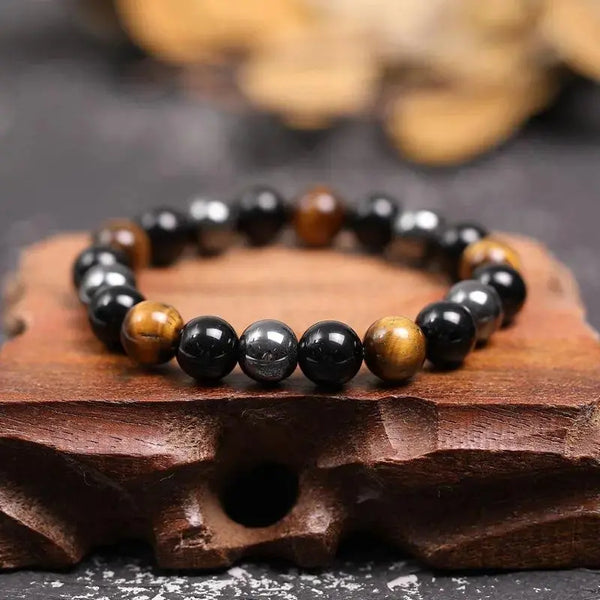
Shop our Tiger Eye Buddhist Bracelets.
Can You Wear Multiple Buddhist Crystal Bracelets Together?
You do not have to commit to one stone forever. Many people build a bracelet stack—a layered wrist combination that changes based on mood, outfit, or current intention.
In jewelry circles, this is often called a wristscape: using different textures, colors, and materials to create a look that feels personal rather than pre-styled.
Stacking Combinations That Work
- Protection Stack: Start with Black Obsidian (8mm) closest to your hand, then Hematite (6mm) in the middle, finishing with sandalwood Mala beads (10mm) nearest your elbow. The graduated bead sizes create a tapered effect that prevents the stack from looking bulky. If you are wearing a watch, swap the order—place the heaviest bracelet (Hematite) directly next to the watch face to keep the stack from sliding under it.
- Calm & Mindfulness Stack: Amethyst + Lava Stone. A softer combination suited to meditation and everyday relaxation. Add 1 drop of lavender oil to the Lava Stone beads for an extra sensory layer.
- Confidence & Success Stack: Tiger Eye + Black Obsidian. Warm golden tones against deep black create strong visual contrast. Both stones are durable enough for daily wear.
- Abundance Stack: Jade + Tiger Eye. A balanced mix of prosperity symbolism and confident energy, with green and gold tones that complement each other naturally.
Many customers also mix Buddhist bracelets with watches, leather bands, or simple metal accessories. The contrast between natural stone and modern hardware creates a style that feels intentional rather than traditional.
Which Wrist Should You Wear a Buddhist Bracelet On?
One of the most common questions after choosing a bracelet is: "Which wrist?"
Some spiritual traditions associate the left wrist with receiving energy and the right with giving or releasing.
Others prioritize comfort and personal connection over any specific rule.
From a mindfulness perspective, the most meaningful choice is whichever wrist helps you stay connected to your intention.
If you naturally reach for your bracelet with your left hand during meditation, wear it there. If your right wrist feels more comfortable during daily activities, that is fine too.
Many people switch wrists depending on their routine—wearing it on their dominant hand during meditation, then moving it to the opposite wrist when stacking with a watch.
A Buddhist bracelet is meant to support your practice, not create anxiety about whether you are wearing it correctly.
Learn more in our guide: Buddhist Bracelet Wearing Guide.
How to Measure Your Wrist for a Beaded Bracelet
Getting the right fit matters—too tight and the elastic wears out quickly; too loose and the bracelet slides around or catches on things. Here is a simple method that takes less than a minute.
What you need: A flexible measuring tape, or a strip of paper and a ruler.
Steps:
- Wrap the measuring tape (or paper strip) around your wrist just below the wrist bone—the spot where you would naturally wear a watch.
- Pull it snug but not tight. You want the measurement of your wrist, not a compression fit.
- If using paper, mark where it overlaps, then measure the length with a ruler.
- Add 0.5 inches to your wrist measurement for a standard fit, or 0.75 inches if you prefer a looser drape.
Bead size matters too: 6mm beads look more delicate and work well for stacking. 8mm is the most common size—substantial without being bulky. 10mm beads make a stronger visual statement but feel heavier on the wrist. If you plan to stack bracelets on the same wrist as a watch, consider sizing up slightly to prevent the bracelets from crowding the watch face.
How to Care for Your Buddhist Crystal Bracelet
Natural stone bracelets are made to be worn, but a little attention preserves their appearance and structural integrity over time.
I think of bracelet care as another small mindfulness practice. Instead of treating your bracelet as disposable, the act of cleaning and caring for it reconnects you to the intention behind why you chose it.
Daily Care Tips
- Apply perfume and cologne before putting on your bracelet, not after. Alcohol and synthetic fragrances can dull certain stones and weaken elastic cord over time.
- Wipe it down with a dry microfiber cloth every few days to remove skin oils and dust. No water, no cleaning solutions needed for routine maintenance.
- Remove before swimming, hot tubs, or long showers. Chlorine and prolonged moisture are the two biggest threats to elastic cord longevity.
- Store flat or loosely coiled in a jewelry pouch—not hanging, which stretches the elastic unnecessarily.
When to Replace the Cord
Elastic cord typically lasts 12–18 months with daily wear. Signs it is time to restring: the bracelet feels looser than when you bought it, the cord looks fuzzy or frayed between beads, or beads no longer sit snugly against each other.
Restringing is straightforward and any local jeweler can do it for a small fee—or we can recommend a restringing service if you contact us.
Some people also enjoy personal cleansing rituals: leaving the bracelet in moonlight overnight, holding it during meditation, or setting a new intention.
These practices are optional. The meaning comes from the relationship you build with the piece over time, not from following a prescribed ritual.
For more detailed instructions, visit our Buddhist Bracelet Care Guide.
What Makes a Buddhist Bracelet Different From a Regular Crystal Bracelet?
At first glance, a Buddhist bracelet and a regular crystal bracelet can look similar. Both may feature natural stones and handcrafted designs. The practical difference comes down to design and purpose.
A standard crystal bracelet is typically made with uniform beads on a single elastic cord—it is jewelry first. A Buddhist-inspired bracelet often incorporates design elements borrowed from traditional mala beads: a guru bead (a larger bead marking the start and end point), a tassel (originally used to symbolically wipe away distractions during meditation), or a specific bead count (multiples of 9 or 27 rather than arbitrary numbers).
More importantly, a Buddhist bracelet is designed to be touched. The cord is often knotted between beads to create space for finger-counting during meditation. The beads themselves are chosen not just for color but for texture—something your fingers will want to return to throughout the day.
It is the difference between something you wear and something you use.
Why We Do Not Sell Dyed or Heat-Treated Stones
The crystal jewelry market has a transparency problem. Many stones sold online are dyed, heat-treated, or outright mislabeled—dyed Howlite labeled as Turquoise, heat-treated Amethyst sold as Citrine, green-dyed Quartz called Jade.
These treatments are not always disclosed, and they change not just the appearance but the long-term behavior of the stone.
Here is what we do differently:
- No dyed stones. The color you see is what the earth produced. Our Black Obsidian may show natural gray banding; our Amethyst varies from lavender to violet depending on the light. These variations are not flaws—they are evidence the stone has not been artificially homogenized.
- No heat treatment. Heat-treated Amethyst turns brownish-orange and is often sold as Citrine. We do not do this. Our stones are untreated, which means natural color variation is part of the product.
- Transparent sourcing. We list the origin of each stone type on its product page—our Obsidian comes from Mexico, Nephrite Jade from Canada, Tiger Eye from South Africa. If a stone's origin matters to you, you can find it before you buy.
What to expect over time: Untreated natural stones change subtly with wear. Tiger Eye beads may deepen slightly in color after months of contact with skin oils—this is normal and expected. Lava Stone will darken if you use essential oils regularly. These changes are part of the bracelet becoming yours, not a defect.
One Month With This Bracelet: Notes From a Wearer
Black Obsidian Bracelet — 4 Weeks In
Week 1: Kept forgetting I was wearing it. Noticed it mostly while typing—the beads make a faint clicking sound against my laptop. Not unpleasant.
Week 2: Caught myself reaching for the beads during a stressful call without thinking about it. Just rolling one between my fingers. Realized after the call ended that I had done it the whole time.
Week 3: The elastic has loosened slightly—the bracelet now sits about half an inch lower on my wrist. More comfortable there, actually. The beads feel warmer against my skin than they did fresh out of the package.
Week 4: A coworker asked about it. I heard myself saying, "It is just a reminder to stay grounded," and realized I meant it. Did not feel self-conscious saying it out loud. That surprised me.
These notes were shared by a Karma & Renewal customer who bought their first bracelet in January. We asked if we could publish them; they said yes on the condition we not use their full name. We think that makes it better.
Frequently Asked Questions About Buddhist Bracelets & Crystal Meanings
What is the meaning of a Buddhist bracelet?
A Buddhist bracelet is a bracelet inspired by Buddhist traditions of using beads as tools for mindfulness. Historically, Buddhist monks used mala beads—strands of 108 beads—to count mantras or prostrations during meditation. Modern Buddhist-inspired bracelets adapt this concept into a wearable form.
For most Western wearers, they function as a physical touchpoint: noticing the beads on your wrist during the day is an invitation to take one conscious breath or return attention to the present moment. The specific stone adds a layer of personal meaning that reinforces the wearer's intention, whether that is protection, calm, or focus.
Which Buddhist bracelet is best for protection?
Black Obsidian and Hematite are the most popular choices for protection-focused Buddhist bracelets. Black Obsidian is associated with grounding and boundary-setting—many wearers describe it as a reminder to protect their peace rather than absorb external negativity.
Hematite, with its noticeable weight and metallic finish, provides a tactile grounding sensation that some people find helpful during high-stress situations. Both stones have a dark, minimal appearance that works for daily wear in any setting.
What crystal bracelet is good for calm and relaxation?
Amethyst and Lava Stone are the two stones most commonly chosen for calm-focused bracelets. Amethyst has a naturally soft purple tone that many people associate with quiet and reflection.
Lava Stone offers a different kind of calm—its rough, porous texture provides tactile grounding, and it can be used with essential oils (lavender, chamomile, sandalwood) for an additional sensory layer. Neither stone is a substitute for professional mental health support, but both can serve as physical anchors in a personal mindfulness practice.
Can I wear a Buddhist bracelet if I am not Buddhist?
Yes. Buddhist-inspired bracelets are worn by people of all backgrounds—and none. Most wearers are drawn to the combination of natural materials, mindfulness symbolism, and craftsmanship rather than a specific religious practice.
You do not need to follow Buddhism to appreciate or benefit from a bracelet designed as a reminder for presence and intention. That said, we encourage learning about the traditions these designs draw from; understanding where something comes from deepens its meaning.
Can I wear more than one Buddhist bracelet at the same time?
Absolutely. Bracelet stacking is one of the most popular ways to wear Buddhist crystal bracelets. Many people combine protection stones like Black Obsidian with confidence stones like Tiger Eye, or calming stones like Amethyst with grounding Lava Stone.
The key to a comfortable stack is varying bead sizes (graduating from smaller to larger beads) and not exceeding 3–4 bracelets on one wrist, which can strain the elastic cords and feel bulky.
How do I choose the right crystal bracelet?
Start with your personal intention. Ask yourself what you want the bracelet to represent in your daily life—protection, calm, confidence, abundance, or mindfulness.
Then check the durability table above to make sure the stone fits your lifestyle. If you are still unsure, Hematite is a good neutral starting point: it is understated, noticeably weighted, and pairs easily with any future additions to your stack.
Which wrist should I wear my Buddhist bracelet on?
Different traditions offer different interpretations—some associate the left wrist with receiving and the right with releasing. From a practical standpoint, most people wear their bracelet on whichever wrist feels natural.
If you wear a watch daily, the opposite wrist usually works best. There is no wrong choice. What matters is that the placement supports your connection to the bracelet's intention, not that it follows an external rule.
Are crystal meanings based on Buddhist teachings?
Crystal meanings come from a variety of cultural traditions, spiritual practices, and modern interpretations—not exclusively from Buddhist teachings. Historical Buddhism does not include a systematic "crystal healing" doctrine.
The stones used in Buddhist-inspired bracelets today carry symbolism drawn from multiple sources: Asian cultural traditions around Jade, Western crystal healing practices, and contemporary wellness approaches to mindfulness. We present these meanings as symbolic associations that many people find personally meaningful, not as doctrinal claims.
Quick Pick: 30-Second Decision Guide
If you have made it this far and still are not sure, here is the shortest version:
Find the Buddhist Bracelet That Matches Your Intention
The right bracelet is not always the one with the most expensive stone or the most intricate design.
Sometimes it is the bracelet you naturally reach for every morning. The one that reminds you to slow down before a busy day, breathe during stressful moments, or reconnect with the intention you set for yourself—the one that becomes so familiar on your wrist that its absence feels like forgetting your keys.
Whether you are drawn to the grounding weight of Black Obsidian, the quiet presence of Amethyst, the prosperity symbolism of Jade, or the forward momentum of Tiger Eye, your Buddhist bracelet becomes meaningful through the relationship you build with it over time.
Explore our complete collection of Buddha Bracelets for Mindfulness, Protection & Spiritual Balance and find the stone combination that feels right for your journey.


